
It’s Earth Day, and this year’s official motto is “Our Power, Our Planet™.”
It’s Earth Day, and this year’s official motto is “Our Power, Our Planet™.”
Each year, the world marks Earth Day to draw attention to environmental issues and the steps we can take to save the planet whether it through activism, transitioning to environmentally friendly technologies, or making simple changes like reducing waste or changing dietary habits.
There has been a great deal of progress with the Earth Day movement, but after 56 years of celebrating Earth, why is it still so difficult to convince people to take real measures to protect our environment? Why aren’t our governments doing more to ensure a healthy future for the next generation? The answer is complex, but one of the reasons is that people don’t see an immediate impact – both positive and negative – that their actions have on the environment on a global scale.
What We Don’t See
The biodiversity of our planet is in rapid decline. Between 1970 and 2016, animal population sizes experienced a decline of an average of 68%. In fact, more than 500 animal species are likely to be lost within 20 years. The reason? Loss or change of habitats most of us will never see in person, let alone understand how those changes impacted biodiversity. Here are just a few examples of how AI can change that!
Seeing the Forest for Trees
Forest Foresight is a World Wildlife Foundation (WWF) initiative that employs AI technology to prevent illegal deforestation, which is usually done to create agricultural land for beef production. This has dire consequences. Forests are home to 80% of the world’s land mammals.
Using AI along with the data-driven modelling capabilities, Forest Foresight can predict forest loss up to six months in advance with 80% accuracy! Automated alerts let stakeholders know the need for investigation and even intervention, thereby transforming data into action.
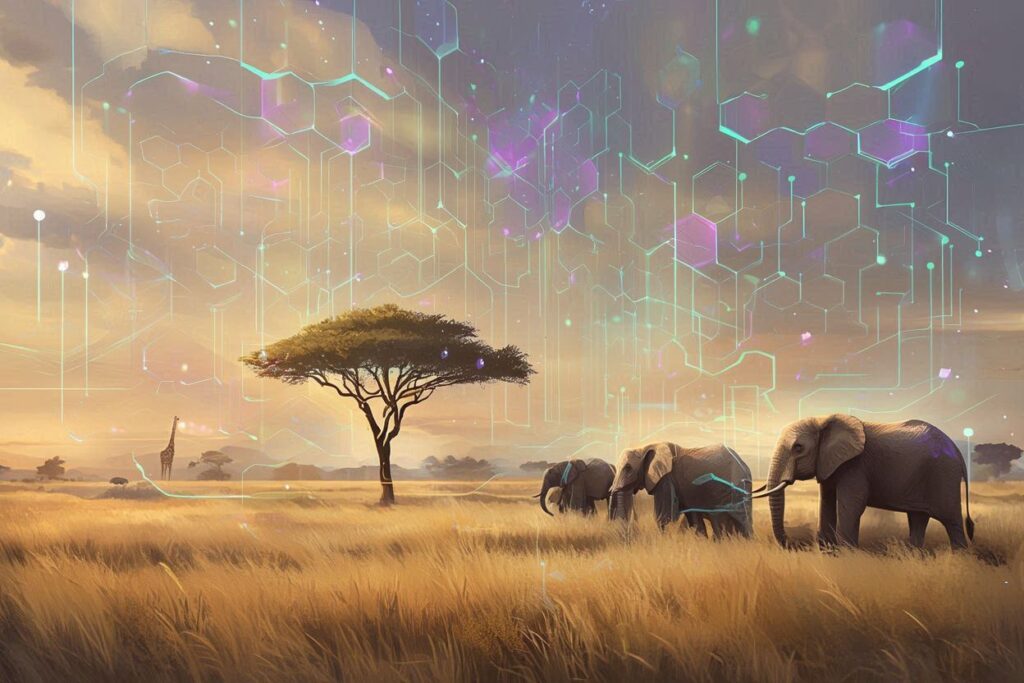
AI-generated artistic representation of the African savanna with a digital overlay protecting it that incorporates some purple and teal hues
A Bird’s Eye View of the Savanna
Vultures do not evoke a positive response in most humans. It’s unpleasant to think of large bird cleaning a carcass, but their behavior can help us prevent poaching, which includes the illegal hunting of animals for meat and fur, overfishing, and illegal wildlife trade. The Gaia Initiative equips vultures with transmitters that use cameras to record images. Then, an AI algorithm runs directly on the transmitter and analyses the movement data. In turn, this can act as a warning system to identify areas where poachers are prevalent.
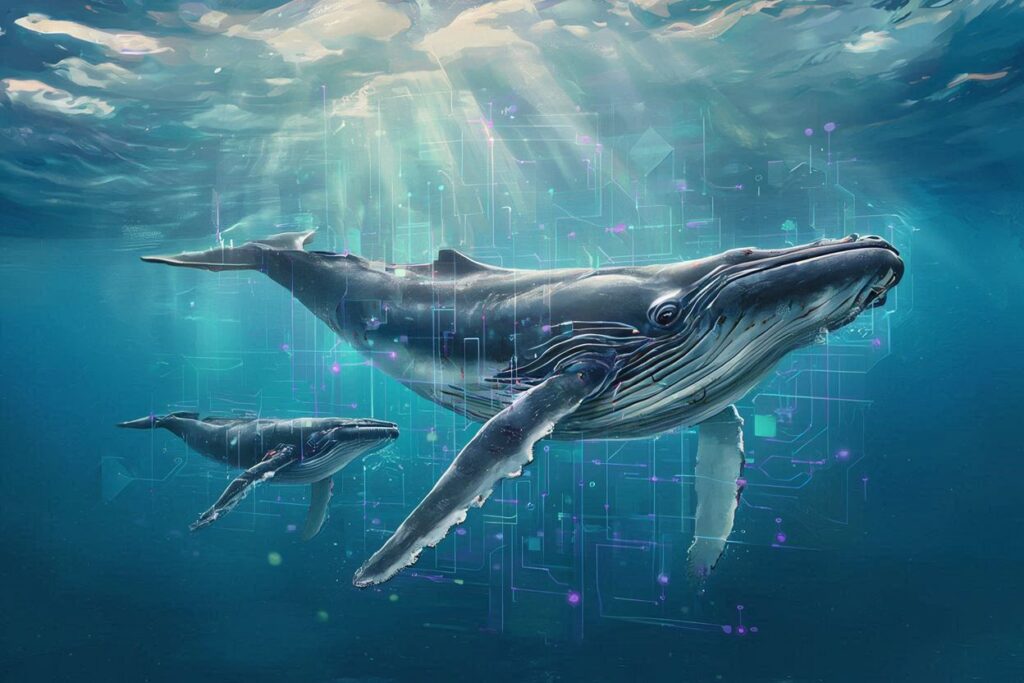
AI-generated artistic representation of blue whales in the ocean with a digital overlay protecting them that incorporates some purple and teal hues
A Deep Dive into Our Oceans
Oceans produce over 50% of our oxygen, regulate climate, and provide food for over 3 billion people. Whales play a bigger role in protecting the oceans than you might expect. For example, they actually lock carbon away from our atmosphere. Their eating habits provide a natural balance of marine life species.
Perch 2.0, Google DeepMind’s bioacoustics foundation model, combines AI and bioacoustics to scale insights for underwater marine ecosystems, particularly for classifying whale vocalizations. This could have a huge positive impact on protecting the environment. Essentially, we can hear whales even in deep oceans to better understand and in turn protect their habits. Specifically, we could use the information to alert ships to avoid collisions, inform fishing zones to reduce entanglement risk, and trigger dynamic marine protections when whales are nearby.
In short, we have the power to protect (and understand) our planet!
Sources:
https://www.earthday.org/
https://earth.org/the-biggest-environmental-problems-of-our-lifetime/
https://www.sciencedirect.com/science/article/abs/pii/S0272494404000660
https://www.wwf.nl/globalassets/pdf/forest-foresight/wwf-forest-foresight-prospectus.pdf
https://beforest.co/blogs/poaching-its-effect-on-natural-ecosystems/
https://en.reset.org/the-gaia-initiative-uses-ai-animal-transmitters-and-vultures-to-protect-against-epidemics-and-poaching/
https://www.un.org/en/desa/5-reasons-you-should-care-about-our-ocean#:~:text=Without%20significant%20change%2C%20UNESCO%20predicts,may%20face%20extinction%20by%202100.&text=The%20ocean%20provides%20livelihoods%20to,provide%2057%20million%20jobs%20globally
https://wwfwhales.org/news-stories/whales-nature-based-buffers-against-the-climate-crisis
https://research.google/blog/how-ai-trained-on-birds-is-surfacing-underwater-mysteries/