

By 2015, 4G roll-outs and looming 5G upgrades had turned carrier networks into hyper-complex, heterogeneous systems. Troubleshooting still relied on human “war rooms” that pored over alarms 24/7, generating high OPEX and hours-long outages. Senior leadership at major mobile-network hardware company (referred to as MNHC here after) — a hardware-centric giant serving AT&T, Vodafone, and others—sought a software leap that could slash downtime and open new revenue streams.
The Challenge
MNHC asked Mind Moves to conceive and lead an innovation program that would use machine learning to detect network anomalies, identify root causes, and shift the company toward AI-driven service delivery. The mandate: deliver a production-ready solution within two years and prove that AI could materially outperform human experts.
Our Solution
Data Opportunity Roadmap:
Educate: Delivered an introductory course on data science and AI, equipping participants with foundational concepts, hands-on exercises, and practical use-case demonstrations.
Ideate & Rank (Flare/Focus): Led cross-functional workshops with R&D, Product, and field engineers in the US, Scandanavia, Israel, and Germany.
Generated 30 ML use-cases, developed a weighted scorecard (market size, customer pain, ROI, time-to-value) to rank opportunities
Pick a winner: secured unanimous executive buy-in for one: automated anomaly detection + root-cause analysis.
MVP Build
Formed an agile squad; designed a micro-services architecture (ETL, feature store, ensemble anomaly models) sized for 100 TB of telemetry and 1,000 requests per second inference. Down-sampled data to deliver early wins while a 15-node Spark cluster was procured. Achieved SME-level sensitivity/specificity on a 1 TB pilot data set covering 1,000 antennas.
Pilot at Scale
Hardened pipelines, lifted balanced accuracy by 20 %, and added an intuitive drill-down UI. Deployed pilots with T-Mobile, Vodafone NZ, and two Asian carriers; models surfaced faults in minutes that previously took days. Introduced preventive-maintenance forecasting service and proposed a security product that could detect cyber-attacks.
Commercialization Blueprint
Authored SaaS reference design, pricing tiers, and GTM plan; transitioned code and roadmap to MNHC’s product team for full cloud scale-out.
Results
- First-to-market AIOps platform launched 2017; now bundled with every RAN deal.
- AIOps—often confused with MLOps—uses AI to tackle DevOps challenges, spotting and predicting issues in real time. Think of it as predictive maintenance for networks: the system flags likely failures before they disrupt service.
- 30 % improvement in mean-time-between-failures (MTBF) for carrier customers; outages detected hours earlier.
- >$1 billion in annual new revenue; software gross margins >70 % versus hardware’s mid-30s.
- Cultural pivot: MNHC established a permanent AI business unit and spun up multiple follow-on ML products within three years.
- Industry impact: Competitors Huawei and others subsequently announced similar offerings, validating MNHC’s lead.
By guiding MNHC from ideation through pilot to SaaS blueprint, Mind Moves turned a manual, cost-center process into a billion-dollar, AI-driven product line—cementing MNHC’s shift from pure hardware vendor to software innovator.
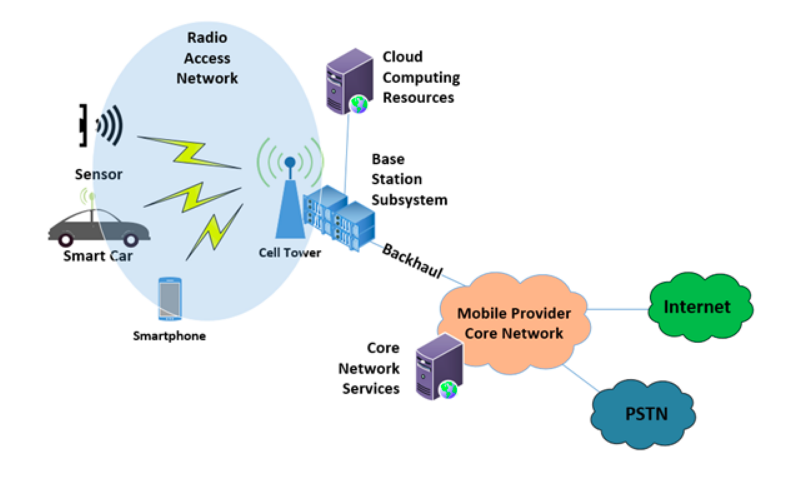
Cellular network: mobile devices connect wirelessly to local towers, which hand traffic to the core network—the back-end system that authenticates users, routes calls/data, and links to the internet—delivering high-speed digital voice and data end-to-end.